
Beyond Awareness: How Touch Expands the Possibilities of Somatic Psychotherapy

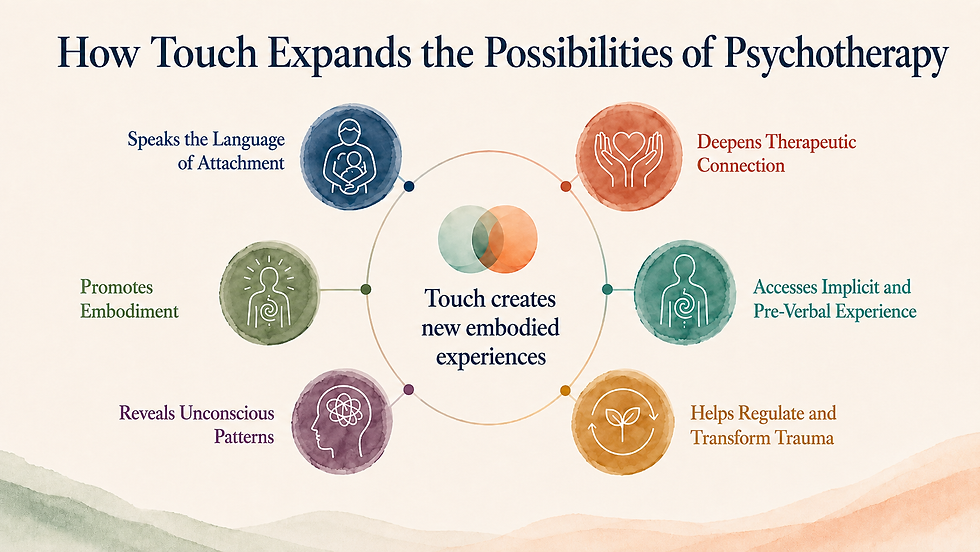
1. Attachment | 2. Therapeutic Connection | 3. Implicit Experience | 4. Unconscious Patterns | 5. Embodiment | 6. Trauma Regulation | Ethics And Consent | The Quality of Touch
Therapeutic touch, used ethically and with consent, can deepen psychotherapy by fostering safety, connection, embodiment, and healing through direct bodily experience.
Somatic psychotherapy is no longer on the margins of the field.
Over the past several decades, research on trauma, attachment, and the nervous system has helped psychotherapy recognize something body-oriented clinicians have understood for a long time: psychological suffering does not live only in thoughts and stories. It is also expressed through breathing, posture, muscular tension, sensation, movement, and automatic patterns of activation, collapse, and protection.
As a result, more therapists are learning to work with the body. They are helping clients notice physical sensations, track nervous-system states, regulate arousal, and become more aware of how past experiences continue to shape their present-moment responses.
This is an important development. It reflects a growing recognition that insight alone is often not enough.
A person may understand why they freeze in conflict, why they struggle to trust, or why closeness feels threatening. Yet the body may continue to respond as though the original danger is still present. Somatic therapy helps bring those responses into the room, where they can be noticed and worked with directly.
But much of contemporary somatic psychotherapy still works with the body primarily through awareness.
The therapist invites the client to notice a sensation, follow the breath, track an impulse, or become aware of tension. This can be deeply valuable. Yet often it is still one step removed from direct experience.
Touch opens another frontier.
It allows therapy to move from observing the body to communicating directly through it. Attuned touch can offer experiences such as support, protection, boundaries, connection, and co-regulation in real time. It can make visible relational and protective patterns that may remain hidden in conversation. It can also help clients encounter places of numbness, bracing, withdrawal, or immobilization that are difficult to reach through words or awareness alone.
In this sense, touch represents the next evolution of somatic psychotherapy. The field has made an essential shift from working primarily with thoughts to working with the body. Touch extends that evolution by moving from awareness alone toward embodied relational experience. It asks not only, "What is happening in the body?" but also, "What new emotional experiences become possible when a person is met through the body within a safe and attuned therapeutic relationship?"
Rather than simply becoming more aware of old patterns, clients have the opportunity to experience something new—feeling supported where they once felt alone, protected where they once felt unsafe, or empowered to set boundaries where they once felt powerless. These emotionally corrective experiences can reach places that insight and awareness alone often cannot.
This is not a new idea.
Touch has been part of the body-psychotherapy tradition for nearly a century. Beginning with Wilhelm Reich, and continuing through approaches such as Bioenergetic Analysis, Biodynamic Psychology, and other body-oriented therapies, practitioners have explored how physical contact can influence muscular holding, emotional expression, regulation, and relationship.
Yet despite this long history, touch has never been widely adopted within mainstream psychotherapy.
In many clinical settings, it is still viewed primarily through the lens of risk. Therapists are often taught to avoid touch because of concerns about boundaries, dependency, retraumatization, cultural differences, power, and the possibility of sexual or emotional confusion.
These concerns are real and important.
Touch can be harmful when it is imposed, poorly timed, insufficiently discussed, or used to meet the therapist’s needs rather than the client’s. It requires clear ethics, specialized training, ongoing consent, and a high degree of sensitivity to the client’s verbal and nonverbal responses.
But avoiding touch entirely also has consequences.
It can remove from psychotherapy one of the earliest and most powerful channels through which human beings experience comfort, protection, connection, and regulation. It can leave therapists willing to work with the body, but unwilling to engage one of the body’s most fundamental relational languages.
The question, then, is not simply whether therapists should touch clients.
The more useful question is: under what conditions and in what ways touch can become an ethical, clinically meaningful, and deeply attuned part of psychotherapy?
When used with care, consent, and skill, touch is not merely an additional technique. It can become a way of reaching experiences that words cannot fully access and of offering the nervous system new possibilities for connection, agency, and healing.
The following are six ways touch can contribute to the therapeutic process. Each topic will be followed by a case example from applying InterSoma, an innovative touch oriented approach to psychotherapy.
1. Therapeutic Touch Speaks the Language of Attachment
Long before children understand words, they learn about relationship through their bodies.
They experience safety through the tone of a caregiver’s voice, facial expression, movement, proximity, and touch. Being held, soothed, protected, and responded to helps the developing nervous system learn that distress can be regulated and that a loving person can be available during moments of need.
When these experiences are missing, inconsistent, or frightening, a person may understand intellectually that others are trustworthy while their body continues to expect abandonment, intrusion, or disconnection.
Attuned therapeutic touch can provide a direct experience of safe relational contact. Rather than only talking about what support might feel like, the client may begin to experience support in the present moment.
A Case Example
During one session, a client was speaking about her relationship with her mother. At a certain moment, she looked at me and our eyes met in a way that felt different from before. As we stayed mindfully with the connection, I noticed a slight, almost imperceptible movement in her right arm.
When I brought her attention to it, she recognized an impulse to reach toward me and touch my hand. At the same time, she felt embarrassed and afraid that I might reject her.
To make the exploration feel safer, I offered to extend my hand first. I explained that she could simply notice what arose inside her and decide whether she wanted to move toward me, touch my hand, remain where she was, or pull back.
The invitation brought tears. She realized how deeply she had expected her reaching to go unnoticed or unmet, as it often had with her parents.
Over the next several minutes, she slowly explored reaching toward my hand, withdrawing, watching my response, and eventually touching the tips of my fingers. After a few moments of contact, she took a deep breath and her body visibly softened.
She began to experience that another person could be available to her, interested in contact, and willing to meet her without pressuring her.

2. Touch Can Deepen Therapeutic Connection
Many studies have shown that the strength of the therapeutic relationship is the most important factor of emotional healing and growth.
Touch is one of the most direct forms of nonverbal communication.
When it is wanted and attuned, it can communicate care, steadiness, protection, acceptance, and presence. These qualities may be expressed verbally, but touch can allow the client to register them at a more immediate bodily level.
This does not mean that touch automatically strengthens the therapeutic relationship. Poorly timed or insufficiently discussed touch can damage trust. Its meaning depends on the client’s history, culture, boundaries, expectations, and experience in that particular moment.
But when touch emerges from a secure therapeutic relationship and is accompanied by ongoing consent, it can help a client feel not only understood but deeply met.
A Case Example
A client returned from a visit with her family. She saw her parents only several times a year, and these visits were often difficult because her father could be critical, strict, and demeaning.
As we explored how the visit was affecting her in the present moment, I noticed that she seemed unusually uncomfortable in her chair. When I mentioned this, she said that sitting directly across from me made her feel as though I were examining her, much as her father did.
After exploring this experience, I asked what it might be like if I sat beside her rather than directly in front of her.
She agreed, and I first moved my chair to a forty-five-degree angle. She immediately felt some relief. I then moved beside her so that we were facing in the same direction.
At first, this felt awkward. But as we stayed with it, she gradually began to feel that I was supporting her rather than evaluating her. The experience became noticeably different from being with her father. She felt supported instead of scrutinized.
With careful permission, we later explored gentle shoulder-to-shoulder contact as our chairs moved closer together. This deepened her sense of safety and opened the door to exploring her relational patterns directly within our therapeutic relationship.
3. Touch Can Access Implicit and Pre-Verbal Experience
Not all memory takes the form of a clear story.
Earlier experiences may appear through bodily sensations, emotional states, images, movement impulses, expectations, and automatic relational reactions. A client may not remember a specific event, yet their body may become tense, numb, vigilant, or withdrawn in response to closeness.
It is sometimes said that trauma is “stored in the body.” A more accurate understanding is that past experiences shape how the brain and nervous system perceive and respond to present situations. These patterns may operate without conscious narrative memory.
Because touch engages sensory and relational experience directly, it can sometimes bring these implicit patterns into awareness.
A Case Example
A client was exploring a feeling of anxiety that frequently arose in the early morning, when he was only beginning to wake.
After talking about the experience, I invited him to move to the massage table so we could explore it more directly through the body. While he remained fully clothed and lying face up, I offered gentle, attuned touch to an area that seemed closely connected to the anxiety. He remained able to look at me, speak, and stay relationally connected throughout the process.
As we both became more attuned to the experience, he began to feel as though the anxiety surrounded him completely.
“It feels acidic,” he said. “It’s both around me and inside me.”
With the support of the touch and our connection, he was able to remain with the sensation for longer periods without closing down. At one point, he opened his eyes suddenly and said, “I know what this feels like. It feels like being in the womb, surrounded by my mother’s anxiety and unable to escape it.”
Whether or not this was a literal memory, it carried a powerful emotional truth for him. The important difference was that he could now remain present with the experience rather than disconnecting from it.
Touch gave form to an implicit emotional state that had previously been difficult for him to understand or articulate.
4. Touch Can Reveal Unconscious Relational Patterns
People develop intelligent ways of protecting themselves in relationships.
They may brace against closeness, become compliant, disappear emotionally, caretake the other person, disconnect from their own preferences, or tolerate discomfort without speaking. These patterns can be difficult to recognize because they happen automatically and may feel like personality rather than protection.
Touch creates an immediate relational encounter. Even the discussion of touch—before any contact occurs—can reveal important patterns around boundaries, need, trust, choice, and self-protection.
A client may automatically say yes while their body pulls away. They may worry about disappointing the therapist by saying no. They may become concerned about whether the therapist is comfortable. They may stop sensing what they themselves want.
These reactions are not obstacles to the work. They are the work.
When approached without judgment, they can help clients recognize the protective strategies they formed earlier in life and begin experimenting with new choices.
A Case Example
During a couples therapy session, we were exploring one partner’s struggle with what he described as his wife’s “controlling pattern.”
He was open to the possibility that his reaction had deeper roots in his own history, so I invited him to explore it further through touch on the table.
As I moved closer and made contact, he verbally agreed to the touch, but I noticed that his body stiffened and his head moved slightly away from me.
We slowed the process down and became curious about what was happening.
He began to recognize a deeply held expectation that whenever someone approached him, they would want something from him—and that he would be obligated to give it.
This pattern made sense in the context of his childhood. As the oldest of three children raised by an overwhelmed single mother, he often felt responsible for meeting her needs. He had learned to comply outwardly while inwardly feeling trapped and wanting to rebel in order to preserve his autonomy.
This helped illuminate the dynamic in his marriage. When his partner became anxious and tried to create certainty by planning ahead, he felt obligated to respond. At the same time, he experienced her requests as controlling and felt a strong urge to resist.
As he continued sensing the touch, I repeatedly reminded him that he could say no, ask me to move, request a different kind of contact, or stop altogether. Gradually, he began to feel the intention behind the touch as supportive rather than demanding.
This gave him a new experience: receiving care without losing his autonomy.
5. Touch Promotes Embodiment
Many clients can describe their emotional patterns with remarkable insight while remaining disconnected from their immediate bodily experience.
They know why they are anxious but cannot sense the first signs of anxiety arising. They understand their boundaries conceptually but notice them only after those boundaries have been crossed. They can analyze sadness without feeling where sadness lives in the body.
Touch naturally brings attention toward sensation.
Clients may begin noticing warmth, pressure, breath, tension, softening, discomfort, impulses to move, or a desire for more or less contact. This develops interoceptive awareness—the capacity to perceive and make sense of internal bodily signals.
Greater embodiment can help clients recognize their needs sooner, regulate themselves more effectively, and make choices grounded in their actual experience rather than in habit or expectation.
A Case Example
A client was speaking about leaving his job because of significant value differences with his employer. He now needed to find not only a new position, but an entirely new professional direction. He felt overwhelmed by the financial responsibility he carried for his family.
While he was lying on the table, I noticed considerable contraction in his chest, shoulders, and arms.
I reflected that his body seemed prepared for battle, as though this was going to be a struggle and he was facing the situation entirely alone. He recognized this immediately and said that much of his life had felt this way.
I applied gentle, steady pressure to one side of his chest and invited him to bring his attention there. As he stayed with the sensation, that side gradually began to soften. He described feeling as though he were letting go of the fight.
The contrast between the two sides of his chest became very clear. One side remained armored and prepared for struggle, while the other felt more open and at ease. This allowed him to experience his familiar body-mind pattern much more clearly than he had through talking alone.
After both sides had softened, I placed my hands behind his head and invited him to notice the support of my hands and the table beneath him.
This became a new embodied experience: he did not have to carry everything alone. Support could be available to him, and he could allow himself to receive it.
6. Touch Can Help Regulate and Transform Trauma
Trauma affects not only what a person remembers, but also how the nervous system responds in the present.
Often, clients who experienced trauma become highly activated when they feel threatened. Their heart races, their breathing becomes shallow, their muscles tighten, and they may feel overwhelmed by fear, panic, anger, or the urge to escape.
Another common response is to become still, numb, disconnected, collapsed, or unable to speak or act. These responses are often described as freeze, shutdown, or immobilization.
Both activation and shutdown are intelligent survival responses. They are ways the nervous system attempts to protect the person when an experience feels too threatening to manage.
Carefully attuned touch can help regulate these responses by giving the nervous system clear, immediate sensory information about support, safety, boundaries, and connection.
Some examples could be putting the therapist foot on the client’s foot to create more groundedness, firm holding of the hand to give a message of “you’re not alone”, and even containment and holding to feel the boundaries of the body can be significant.
For a client who tends to freeze or shut down, touch can sometimes help bring awareness and movement back into areas that feel numb, absent, or immobilized. It may support the client in noticing impulses that were previously inhibited, such as pushing away, turning, reaching for help, protecting the body, using the voice, or creating distance.
This can be especially important because many frozen trauma responses developed in situations where action was impossible. The person may have wanted to fight, flee, call out, or seek protection but could not do so safely.
In therapy, touch can create an opportunity to approach these responses slowly and with much more choice.
A Case Example
A client who had experienced physical and sexual abuse as a child was lying on the table when I noticed that her arms had very little muscle tone. They appeared heavy and disconnected, as though they would not be able to respond effectively if she needed to protect herself.
As I gently touched her arms and we brought our attention to them together, we began to notice several narrow areas of intense muscular holding beneath the overall sense of collapse.
I offered slow, careful contact to these areas while inviting her to breathe, feel the support of the table, and make very small movements with her fingers.
Gradually, more sensation and vitality began to return to her arms. The movements became clearer, and she experienced them as increasingly available and responsive.
For her, this was connected not only to one traumatic event, but to a series of experiences in which she had felt overpowered and unable to protect herself.
Later, I invited her to press one hand into mine. She began with very little force, and we proceeded slowly, continually checking that she remained present and in control. Over time, she discovered more strength in her arm and allowed herself to push my hand away.
As she did this, she connected with a clear bodily “no.”
The work was not about reenacting the trauma or forcing a release. It was about helping her nervous system move from helplessness and immobilization toward strength, action, and choice.
Through this embodied experience, a new sense of self-protection became possible.
Touch Is Not the Right Intervention for Every Client
Touch should never be treated as a necessary part of healing.
Some clients may not want physical contact. Some may benefit from working explicitly with distance, gesture, movement, objects, self-touch, imagination, or the experience of saying no. For others, the discussion and negotiation of touch may be more therapeutic than touch itself.
A trauma-informed approach does not assume that touch is soothing. It recognizes that touch may evoke safety, longing, grief, fear, shame, anger, confusion, or several of these at once.
This is why consent cannot be reduced to a single question at the beginning of treatment. It is an ongoing process.
The therapist must attend not only to what the client says, but also to hesitation, compliance, tension, withdrawal, changes in breathing, and shifts in emotional presence. At the same time, bodily reactions should not be interpreted as more truthful than the client’s words. They are invitations for curiosity, not reasons to override the client’s stated choice.
The Quality of Touch Matters
Touch is not therapeutic simply because physical contact occurs.
Its potential depends partly on the quality of the therapeutic relationship: the trust, safety, clarity, and respect between therapist and client. But the quality of the touch itself also matters.
Touch communicates intention. It can feel grounding, protective, comforting, spacious, intrusive, uncertain, or demanding. Two touches that look similar from the outside may create very different experiences in the client.
In InterSoma, we pay close attention to subtle shifts in breathing, muscle tone, posture, facial expression, movement, and emotional presence. Is the client softening or bracing? Becoming more present or beginning to withdraw? Moving toward the contact or simply tolerating it?
These responses help the therapist understand what quality of touch is needed. One client may need steadiness and containment. Another may need softness, space, support for movement, or greater distance.
The therapist’s intention is also transmitted through the contact. Touch offered with an agenda to calm, fix, or produce an emotional release can feel very different from touch that is patient, receptive, and responsive.
For this reason, therapeutic touch is a form of nonverbal dialogue. The therapist offers contact, listens to the client’s bodily response, and adjusts the pressure, location, timing, or quality of the touch accordingly.
Good touch is not defined by being gentle or nurturing. It is defined by how accurately it meets the client.
Sometimes the most attuned touch is soft. Sometimes it is firm and containing. Sometimes it supports movement or resistance. And sometimes the most attuned response is not to touch at all.
To learn more about how to work with touch safely, ethically, and skillfully in psychotherapy, explore the InterSoma Foundations Training.
Note: The case examples in this article have been anonymized and identifying details have been changed to protect client confidentiality.
About the Author
Gal Szekely, MFT, is a psychotherapist, couples therapist, and teacher of somatic and mindfulness-based psychotherapy with more than 20 years of clinical experience. He is a certified Hakomi teacher and co-founder of InterSoma, an approach integrating somatic psychotherapy, attachment, relational presence, and conscious attuned touch.
Comments